

Neuromonaco helps marketing directors and SMB/SME leaders to design messages and strategies based on the real decision-making mechanisms
DISCOVER actionable triggers in your business

STRATEGIC ADVICE
To solve your recurring problems
In-depth analysis of the psychological determinants of your problems to find the most effective action axes and implement them.
To define a new strategy
Psychological segmentation, target identification, positioning analysis, and message design.
Recommendations in 2 weeks
Providing a scientifically based report detailing the relevant triggers for your problem and offering ways to activate them.
ACTIVATE triggers to influence decisions
REAL-TIME SUPPORT
Marketing
Whether you need to adjust a campaign, modify an offer, or react to a market signal: we analyze the psychological triggers in 48 hours and adjust your approach before launch.
Communication
Review and reformulation of your messages (landing page, email, sales pitch) based on the cognitive biases of your target audience - turnaround within 72 hours.
Management
Support for key internal decisions (restructuring, negotiation, conflict resolution) where the psychological dimension has a significant impact on the outcome.
Available for short-term assignments (1 to 5 days) or a monthly subscription for priority access.
ACQUIRE the skills to master the triggers
PRACTICAL TRAINING
One-Day Workshops
One morning of training on the chosen theme, followed by an afternoon of practical application to solve your problems immediately.
From A to Z
In daily or short format (2 hours), the training courses that will allow you to acquire the necessary reflexes to implement the psychomarketing tools in autonomy.
SOME REFERENCES
Company in charge of FIFA for football World Cup IT:
Design of an open source social network and operational dashboards for the 2018 Russia World Cup

National Park:
Study and training on communication of restrictions

High Tech Startup:
Support with defining the company’s positioning and creating its website when the company was founded.

Business School:
Master 2 course on consumer behavior

Business School:
Course in Evolutionary Psychology and Neuromarketing (in English)

High-end dietary supplements:
Psychomarketing training for all staff (1 session per month)
FAQ (Frequently Asked Questions)
What is Psychomarketing?
Psychomarketing refers to the human, psychological dimension of marketing.It encompasses both Consumer Behavior and Neuromarketing, which is the application of techniques and discoveries (often counterintuitive) from neuroscience to marketing.
What problems does psychomarketing solve?
The more psychological dimension a problem has, the more effective psychomarketing techniques can be in addressing it.This ranges from simply improving the effectiveness of a marketing campaign to completely redefining a business strategy.
For example, psychomarketing can help to understand why some customers prefer one product over another, even if the differences are minimal.
As an aside, the most frequently asked questions concern *reputation damage* ("my competitors claim that...") and the *redefinition of the strategic positioning* of product lines.
The first result to expect is therefore the resolution of the identified problem. Furthermore, applying psychomarketing techniques allows you to broaden and deepen your knowledge of your market, and therefore increase the value of your other marketing actions.And, most often, a psychomarketing intervention allows you to go much further and redefine your strategy to make it more effective.This is particularly the case when *triggers* are detected and activated.What are the scientific foundations of psychomarketing?
Research in psychology and neuroscience results in hundreds of thousands of scientific articles published each year.Therefore, it is impossible to keep up with everything, but it is possible to "search for solutions" to find answers to one's problems.
The two most widely used fields of study at Neuromonaco are Evolutionary Psychology, which has become the overarching framework for all research, and Psychometrics (the measurement of psychological differences), which has shown that IQ is the most influential factor in predicting individual and collective behavior.These two fields are complemented by research in Cognitive Psychology and Social Psychology.What is a "trigger"?
The world moves too fast for our brains, which are forced to use shortcuts (heuristics) to make choices and decisions. One of these shortcuts is to rely on certain perceived signals that will trigger almost automatic reactions: these specific signals are called triggers.
Therefore, it is enough to master them, i.e., to detect and know how to activate them, in order to provoke the desired reactions. This is the primary objective of psychomarketing.
What is Psychological Segmentation?
Any marketing positioning study is based on the definition of "segments" that quantify each dimension of the market. This segmentation (detection of segments) must be carried out on numerous criteria (age, gender, income, etc.) in order to detect those that are relevant.
As its name suggests, psychological segmentation is based on psychological criteria and is complementary to other segmentations. Its main advantage is that it allows you to determine the underlying motivations of consumers and therefore to better define the messages to transmit to them.
SCIENTIFIC FOUNDATIONS
Neuromonaco is based on more than 30 years of monitoring in psychology and neuroscience, and more than 15 years of experience in psychomarketing and neuromarketing.
Its founder has published several books popularizing scientific psychology, and he notably launched the first French-language website on Evolutionary Psychology in 1997.
450+ quick explanations online of key concepts

Online archives of the 135 Neuromonaco Letters of psychomarketing and neuromarketing.
From Priming to Buy Button, from Psychological Segmentation to Behavioral Triggers, 450+ quick explanations of key concepts in psychomarketing and neuromarketing.
Our goals as humans described and explained.

Gouillou, P. (2014). Why Rich Men's Wives Are Beautiful: Genetic Programming and Sexual Competition (3rd ed., p. 256, Preface: Zayan, R.). De Boeck. ISBN: 978-2-8011-1739-2
To understand Evolutionary Psychology, which is now the overarching framework for research and whose findings offer tools for explaining, *and influencing*, decisions.
This book explains the principles of this approach in clear language and their practical consequences.
How IQ Determines Our Lives and Culture
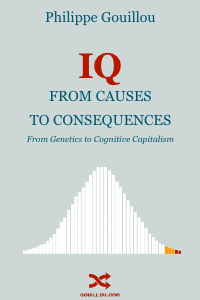
Gouillou, P. (2024). IQ : From Causes to Conséquences - From Genetics to Cognitive Capitalism. Ed. Gouillou.com. ISBN: 978-2-9593985-0-6 (Ebook) 978-2-9593985-1-3 (Print)
IQ approximates the General Factor of Intelligence (g), which is the most influential factor in our psychology, to the point that it is the best predictor of many individual and collective behaviors. It is necessary to take this into account in all marketing strategies.
This book synthesizes all current knowledge on this subject.
